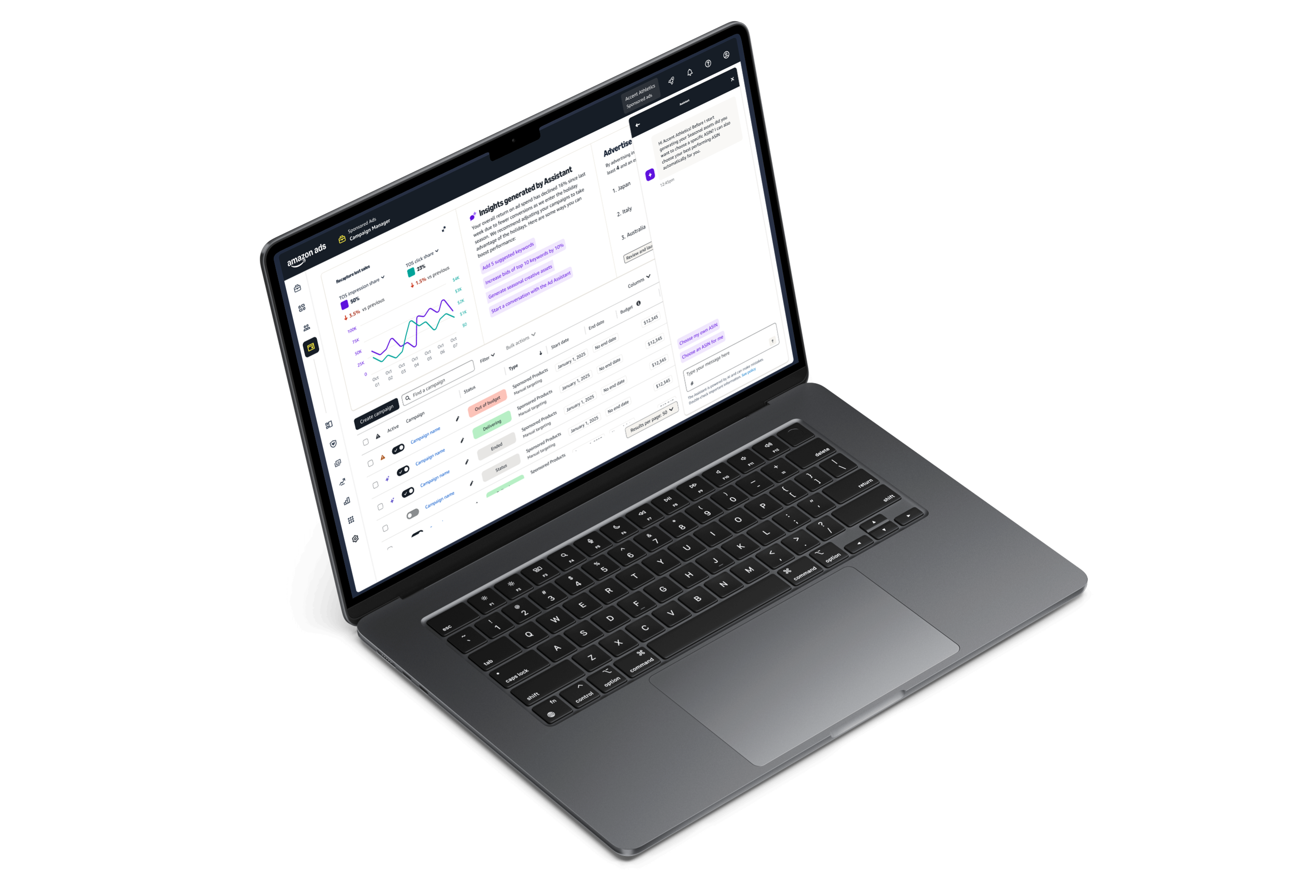
TL;DR I owned design and research for a unified generative AI assistant across the Amazon Ads console, a 12-month, cross-functional effort with 1 PM, 4 SDEs, and 2 data scientists. The long-term vision was never just support: it was an assistant that could walk an advertiser from a question to a launched campaign without leaving the page, surfacing spend recommendations and creative tools along the way. Starting from a support chatbot, I recognized that other teams were independently building their own AI interfaces across the console, and that fragmentation would make that vision impossible. I expanded scope to design a unified platform built on a multi-agent orchestration layer capable of invoking specialized agents for image generation, reporting, keyword generation, and campaign creation. I defined the data architecture with engineering, established four design principles, navigated a VP-level org conflict, and wrote design system guidelines for pattern adoption across teams. The assistant launched with 10 skills and three interaction types, reactive, ambient, and inline, resolving 10% of support cases, eliminating 50k+ tickets, cutting average handle time from 25 minutes to 1.5 minutes, and saving nearly $600k in cost per contact.
The opportunity
The long-term vision for the assistant was to help advertisers create better campaigns, faster, and surface spend recommendations that would keep them active and growing in the console. Support was the entry point because it was the highest volume problem, but the real opportunity was an assistant that could eventually walk an advertiser from a question to a launched campaign without ever leaving the page. After starting work on the support chatbot, I noticed other teams across the console were independently building their own AI-powered experiences, one for image generation, one for reporting, one for campaign creation, each siloed, each starting from scratch. That fragmentation was going to make the bigger vision impossible. An advertiser couldn't move fluidly from support to campaign creation to creative generation if each of those lived in a different interface built by a different team. I made the case to expand scope from a support tool into a unified platform with a multi-agent orchestration layer that all of those agents could plug into.
The goal
Provide advertisers with a cohesive assistant experience across the Ad Console. We defined five success targets going in:
- +5% resolved support cases — resolve 5% or more of support cases with the assistant within the first quarter.
- Launch 5+ agents — integrate multiple specialized agents under a single unified experience.
- −80% avg handle time — reduce support handling time from associate to assistant by at least 80%.
- +5% reports generated — increase NLP-generated reports by 5%.
- +1 campaigns with AI creative — get at least 10% of SMB advertisers to use AI-generated creative from the assistant.
Research
The research surfaced four key findings that shaped the direction:
- Advertiser skepticism toward AI — Past bad chatbot experiences created real hesitation. Trust had to be earned through quality, not promised upfront.
- Low engagement with existing GenAI tools — Standalone experiences on console were underused, signaling a need to reframe how advertisers interact with AI entirely.
- 500k+ annual support contacts — More than 70% were thought to be solvable by an assistant, a significant deflection opportunity.
- Advertisers prefer chat over search — A strong signal that a well-designed assistant could become the primary interaction model on console.
The proposed solution
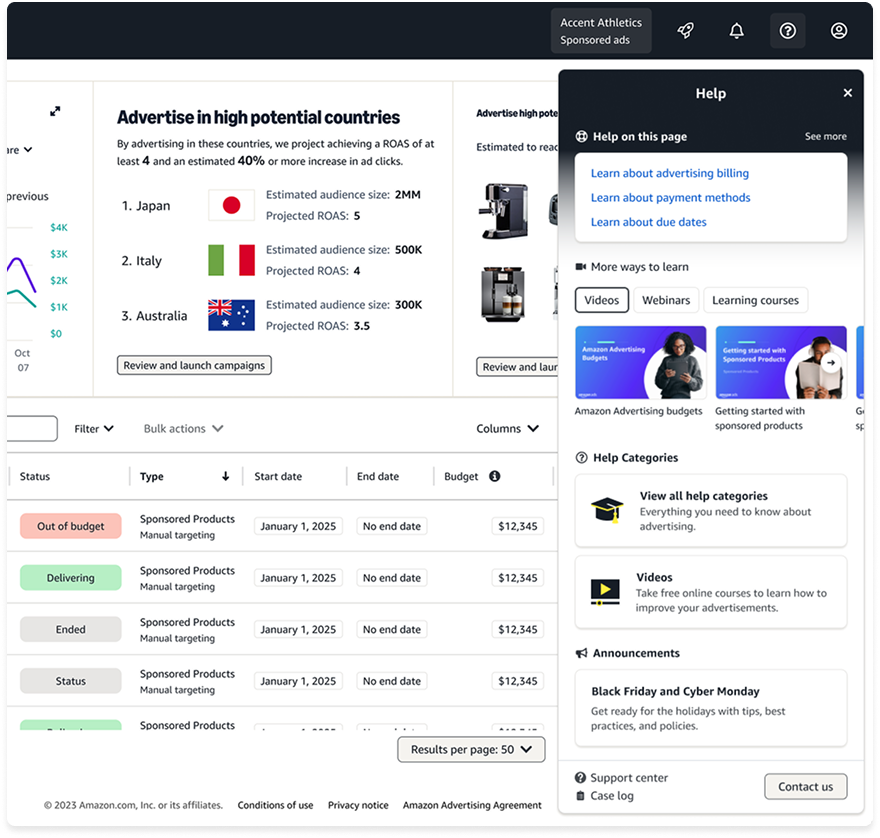
A cross-page unified assistant with the ability to ingress inline and from nudges. This experience would provide not only support but also access to recommendations, image generation, keyword generation, and more — living in the existing help panel with three distinct interaction types for advertisers.
Assistant data structure
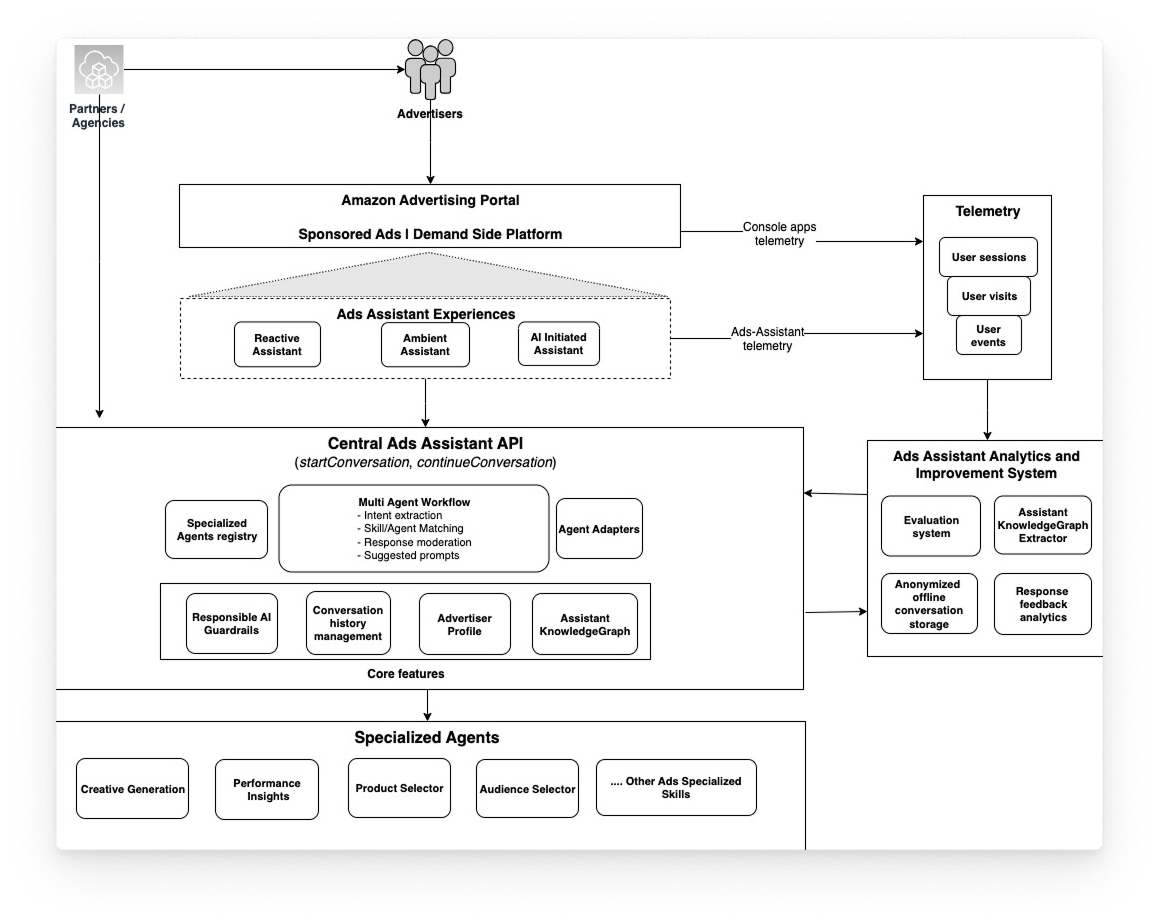
Working with product, engineering, and data science teams to define the assistant architecture. The system is built around a multi-agent orchestration layer with a multi-agent workflow handling intent extraction, skill/agent matching, response moderation, and suggested prompts — backed by a specialized agents registry, conversation history management, advertiser profile, and a responsible AI guardrails layer.
Design principles
We aligned on four principles to guide every design decision:
- Design for imperfection — Generative model outputs may not always meet expectations. Highlight potential flaws and help users understand and work with imperfect outputs.
- Advertiser and consumer needs define AI capabilities — Work backwards from customers to identify needs, then invent on their behalf. We don't work backwards from technology.
- Experimentation and refinement before expansion — Maintain a high bar by testing, learning, and improving AI models before scaling.
- Design optimistically; anticipate rapid AI advancement — Solve for current limitations in a way that enables learning for both AI and customers as the technology evolves.
Design exploration
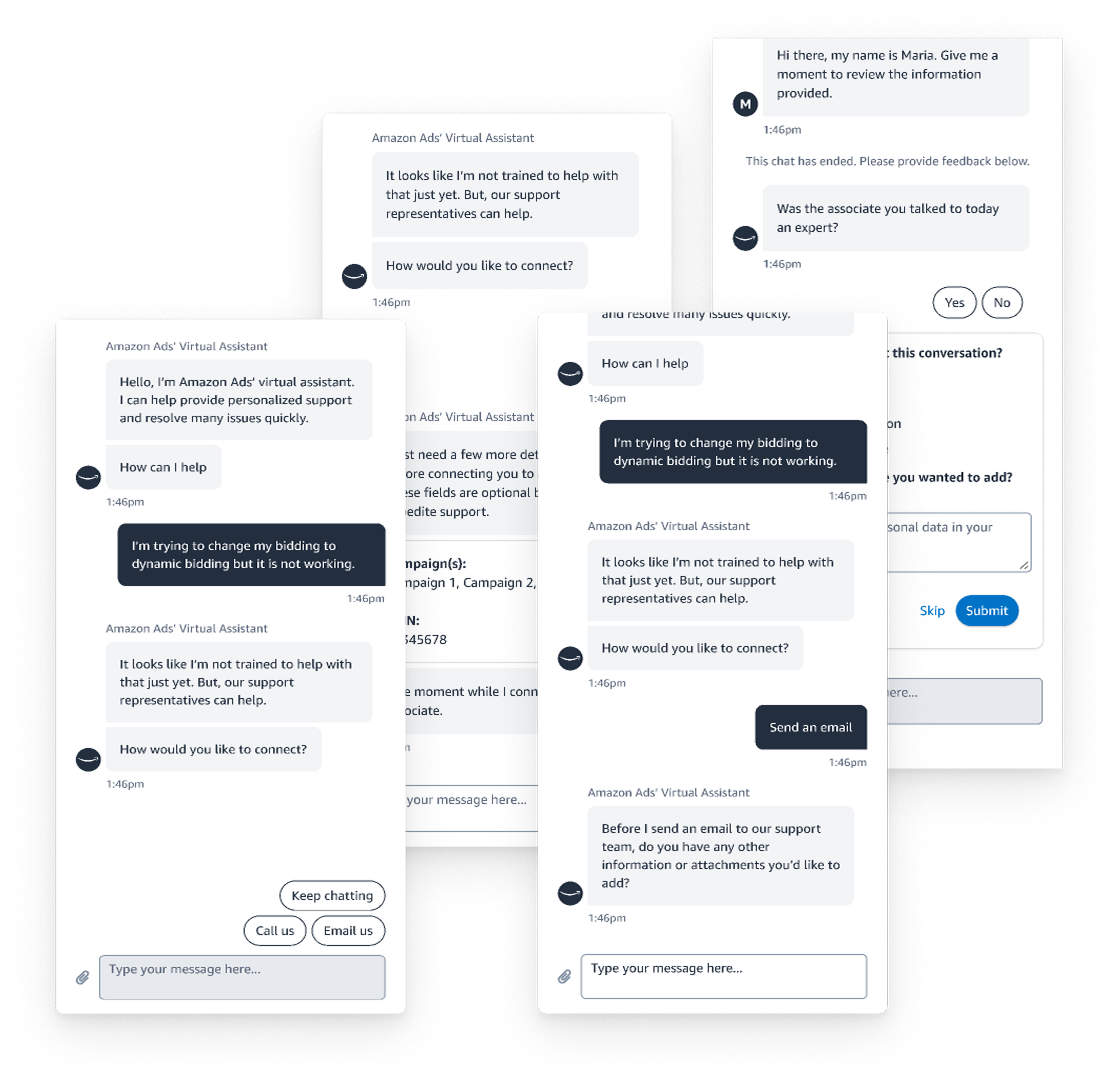
Early 2024 — We started with a redesigned contact us experience, moving toward a conversational intent detection path. This groundwork trained our intent detection accuracy to almost 95%.
Mid 2024 — The next exploration revolved around a conflicting team working on the same solution. This escalated to a VP-level decision where we aligned on our team moving forward with our planned design and the conflicting team owning agent onboarding.
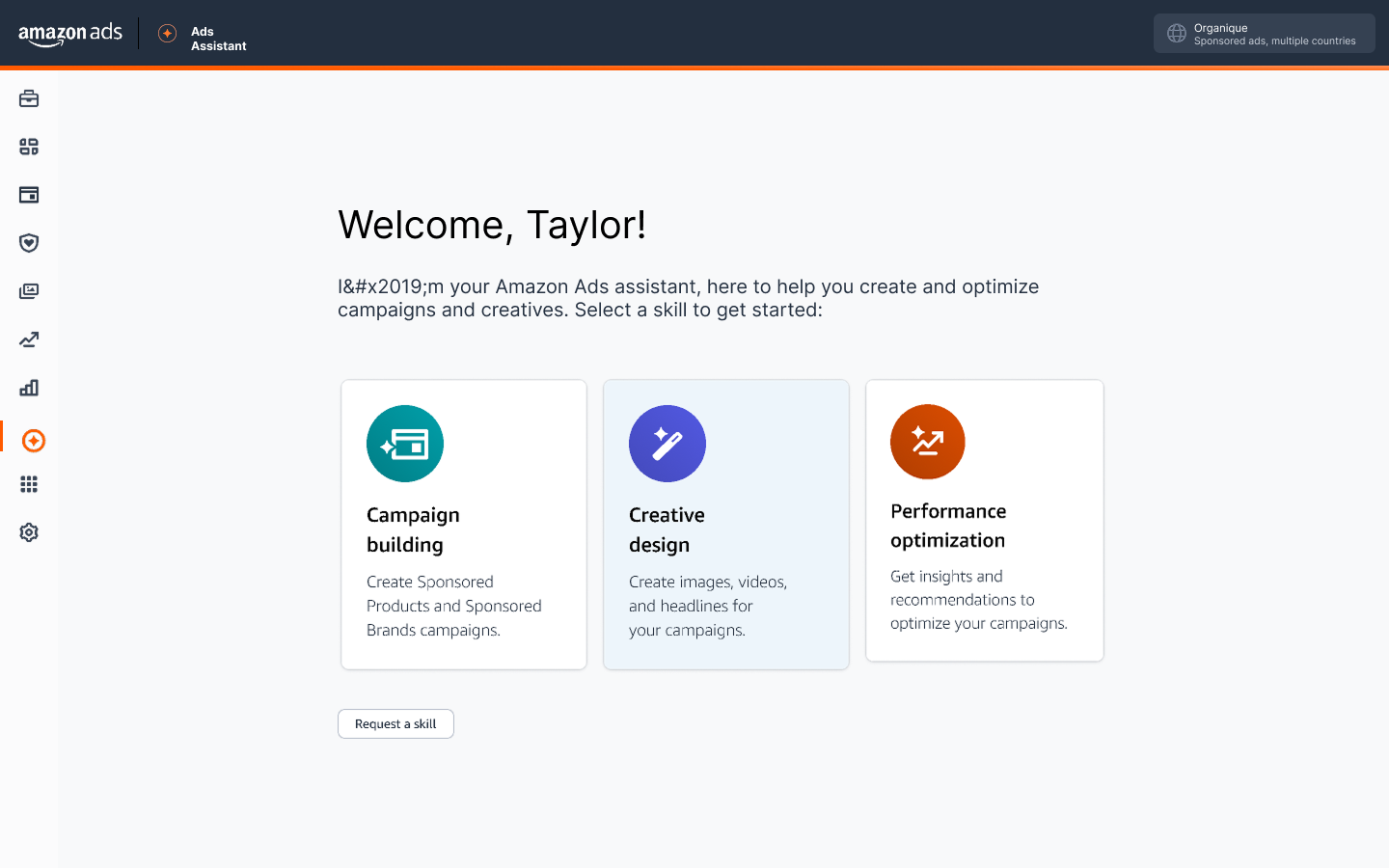
End of 2024 — Nearing the final design, we expanded the functionality by introducing two additional interaction types: proactive nudges and inline experiences contextual to each page. During this time there was also a design system refresh.
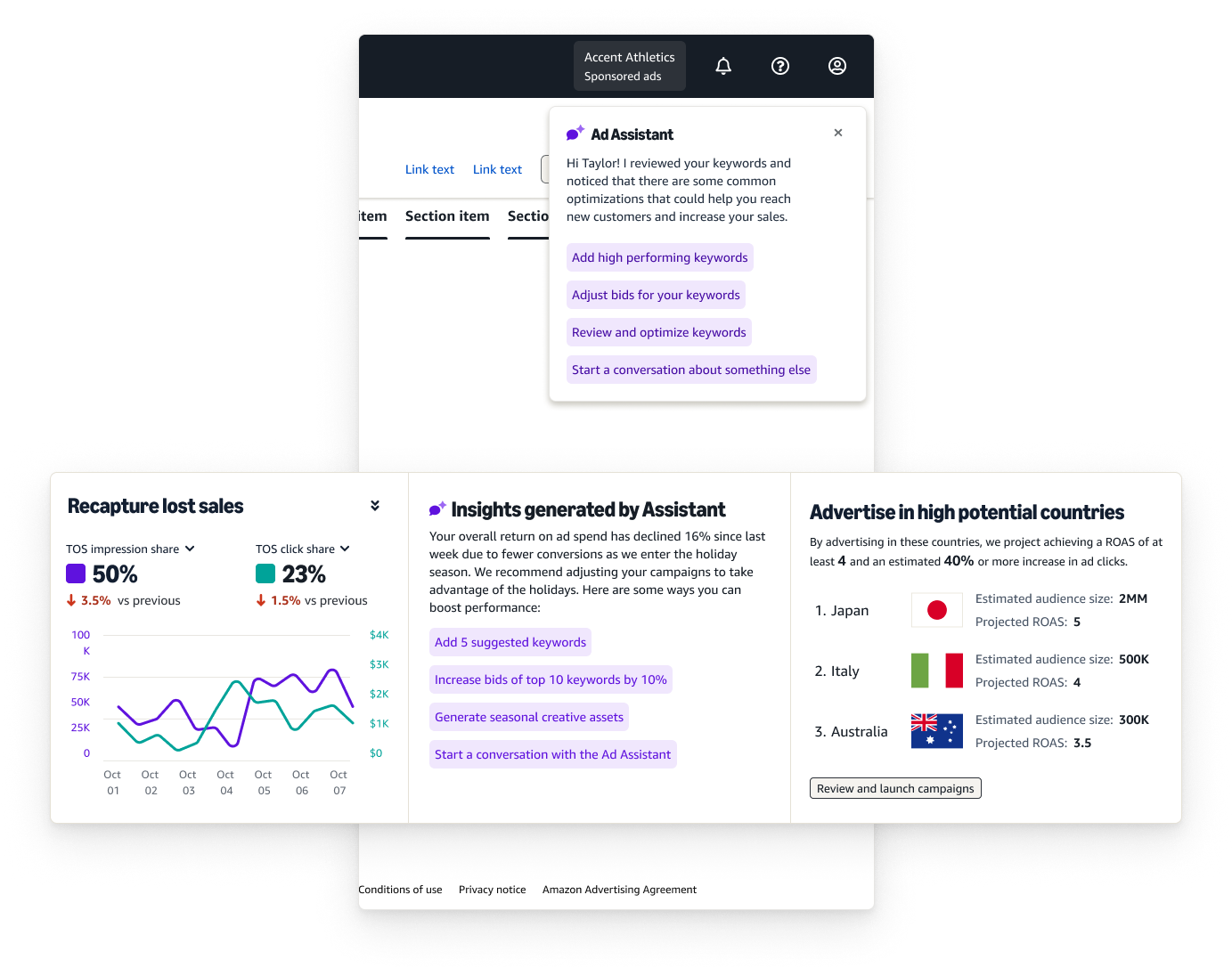
Final design
We launched three interaction types with 10 different skills and counting, focusing on quality of responses before launching each skill completely. At launch we supported: campaign moderation issues, image generation, report generation, billing issues, campaign creation, campaign optimization, advertiser suspensions, invalid clicks, promotional credits, and all education questions.
Design guidelines & handoff
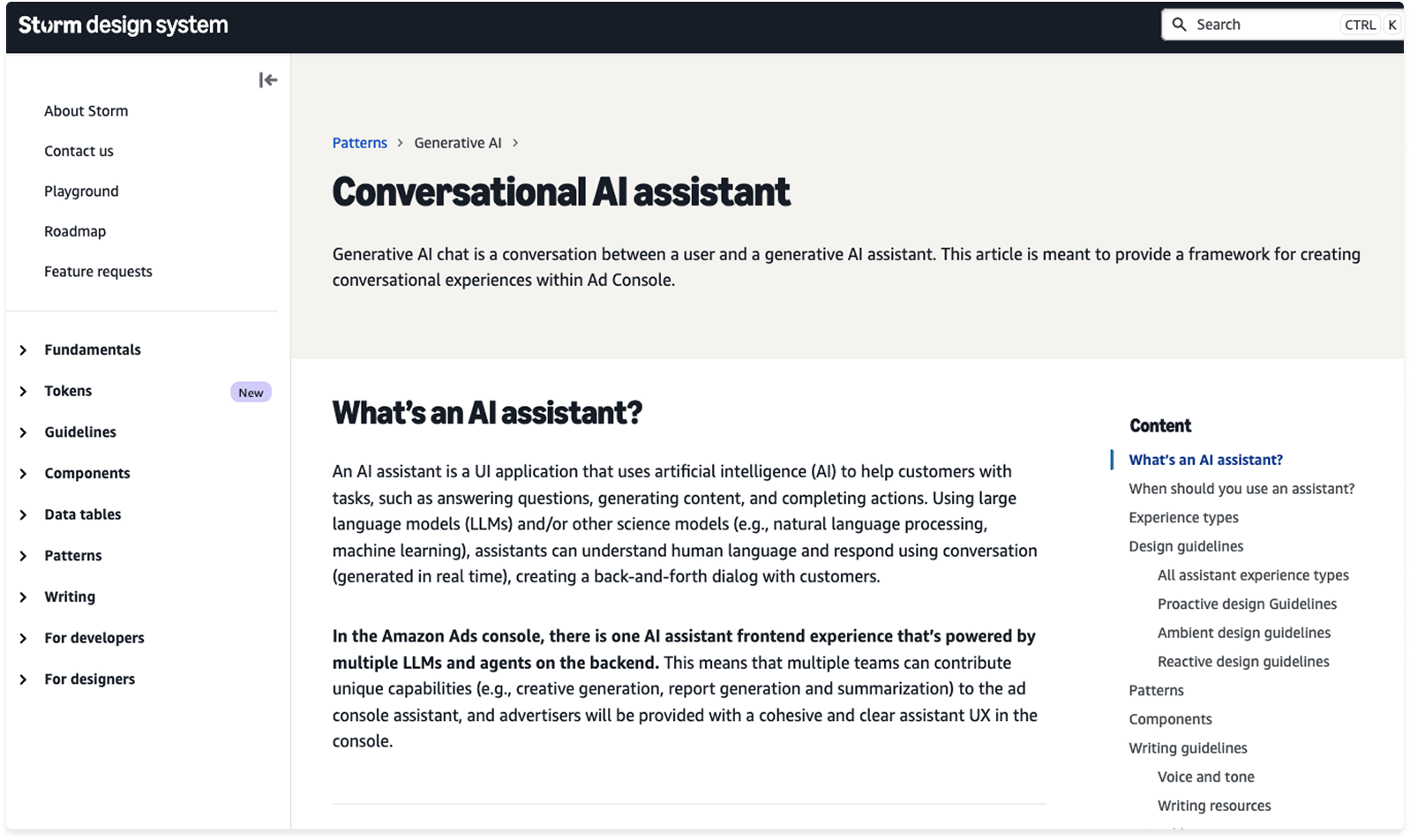
I wrote design system guidelines for the conversational AI assistant pattern in our Storm design system, providing a framework for pattern adherence and adoption across teams.
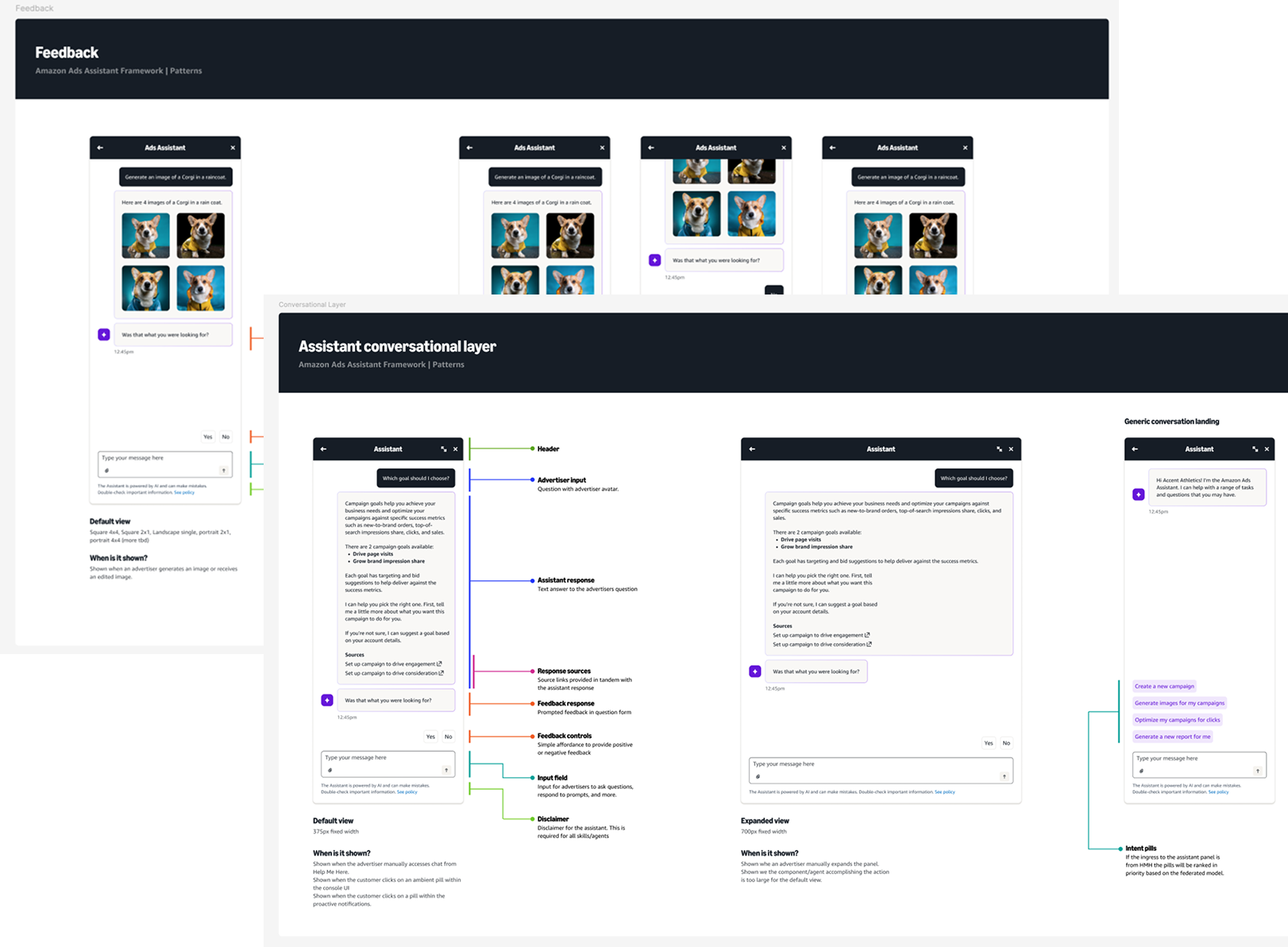
In tandem with the written guidelines I created a framework for both designers and engineers to work from — covering feedback patterns, the conversational layer, input fields, and response sources.
Outcomes
The assistant resolved 10% of support cases, eliminating 50k+ tickets and nearly $600k in cost per contact. Average handle time dropped from 25 minutes to 1.5 minutes. We onboarded 4 partner teams under our framework and introduced more than 10 skills.
What's next
There's also a continued push to collect feedback at scale: are the images generated accurate? Are the goals being suggested providing the right outcomes? Feedback collection will be critical as more skills are onboarded.
Reflections
We nailed our goals and more — making changes at an app level and introducing a new way for product owners to get involved. The only thing I'd tweak is how fast we moved through updates and new features. Slowing down slightly to pressure-test each iteration before moving to the next would have saved some rework down the line.