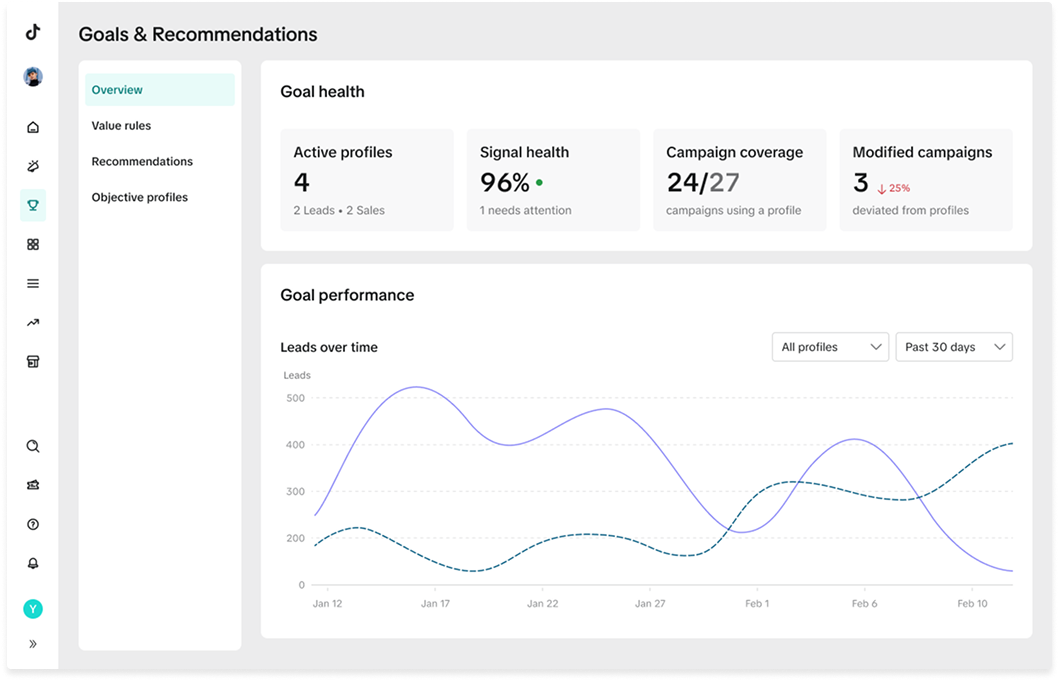
TL;DR I led design and research for Goals Hub — a new account-level intent layer for TikTok Ads that lets every campaign inherit signal instead of rebuilding settings from scratch. The core insight came from research: 7 of 12 key accounts were unknowingly resetting their Learning Phase mid-flight, and the real pain wasn't complexity, it was repetition. Rather than simplifying the campaign form, I reframed the problem as a memory problem. Goals Hub captures intent once at the account level through Account Goals and reusable Objective Profiles, so new campaigns inherit smart defaults and pool conversion signals across campaigns — compressing Learning Phase and reducing misconfigured settings. The design is optional by design, phased to prove UI-layer value before touching the delivery model, and currently in testing.
The problem
Every advertiser rebuilds the same settings from scratch. Sometimes they reset the learning algorithm without knowing it. Budget, targeting, and creative edits mid-flight were resetting Learning Phase for 7 of 12 key accounts — without their knowledge. The pain wasn't complexity, it was repetition.
The opportunity
Move intent upstream. Every campaign inherits signal instead of starting from zero. Goals Hub pools conversion signals across campaigns into one unified container — so 10 websites + 10 form leads + 10 DM leads become 30 pooled signals that exit Learning Phase as a single unified goal rather than three starved learners.
Today the model sees 10 starved learners with account-level goals. With Goals Hub, new campaigns inherit learning from every prior campaign tied to the same goal. 42 CSAT entries and a competitive gap confirmed the opportunity: Google has account-level conversion actions. TikTok has no equivalent.
The goal
Smarter defaults for every advertiser — SMB and Key Account alike. DS projections set the targets:
- −30%+ setup time — reduction in median campaign setup time within 90 days.
- −20%+ abandonment — drop in creation abandonment from intelligent default pre-fill.
- −50% config errors — reduction in misconfigured settings post-publish.
- >40% profile reuse — advertisers reusing saved objective profiles across campaigns.
- KA Learning Phase compression — projected reduction in Learning Phase duration for KAs with 20+ concurrent campaigns via signal pooling.
Research
What told us setup complexity and Learning Phase fragmentation were the real problem:
- 7 of 12 KAs reset learning unknowingly — PSO Q2 2025: budget, targeting, and creative edits mid-flight reset the phase without their knowledge.
- 5.1/10 friction — 54 dogfooding sessions — Repeated decision-making was the top pain point. Not complexity — repetition.
- 20 campaigns = 20 simultaneous Learning Phases — each needs its own 25-conversion requirement. Aggregate time-to-stability far exceeds any single threshold.
- 42 CSAT entries + competitive gap — 402 responses reviewed. Google has account-level conversion actions. TikTok has no equivalent.
- 7-day cap is binding for deep-funnel KAs — high-budget KAs may not hit 25 conversions before the clock. Volatility continues post-label.
The proposed solution
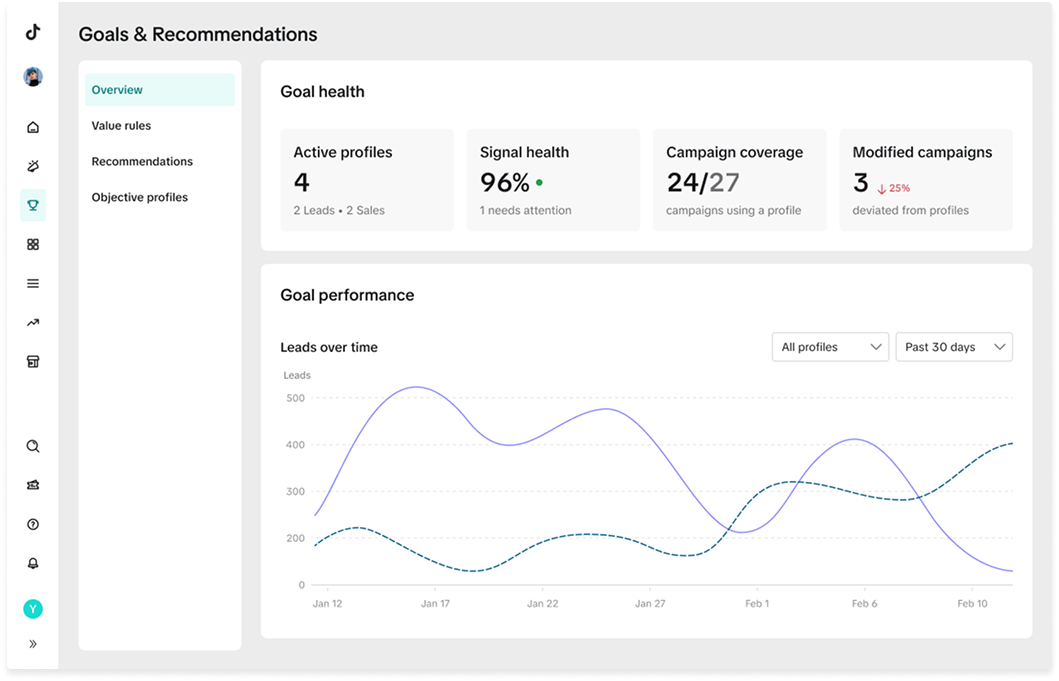
Goals Hub owns the UI layer — intent capture upstream, account-level conversion goals before campaign creation. Built on three layers: Account Goals capture primary outcome, setup posture, and Primary vs. Secondary action hierarchy, defined once before any campaign is created. Objective Profiles translate that intent into reusable per-objective defaults (pixel, event, optimization depth, cost controls, attribution windows) set once and inherited everywhere. Inheritance + Cross-Campaign Signal closes the loop: Phase 1 delivers UI-layer inheritance so every campaign starts from account defaults; Phase 2 enables the delivery model to consume cross-campaign signal — Collective Memory unlocked.
Design decisions
The calls that shaped the system:
- Optional by design — Mandatory flows kill activation. A half-completed intent layer is worse than none. Designed for opt-in with visible value in the first session. Gate: >60% voluntary completion before scaling.
- UI-first, then delivery — Coupling the UI redesign to a delivery model change would have added months and rollout risk. Phase 1 proves intent capture. Phase 2 unlocks pooling.
- Data before design — Led with the research, not the design. 7 of 12 advertisers resetting Learning Phase unknowingly. 25 conversions meaning two different things. Once the room shared the same numbers, "should we" became "how do we."
Design exploration
My first instinct was to simplify the form — fewer fields, smarter defaults, better ordering. I explored that direction for two weeks before the research stopped me. 54 dogfooding sessions. 402 CSAT responses. The friction wasn't the fields themselves. It was seeing the same ones every single campaign. That shifted everything. The design problem wasn't simplification. It was memory.
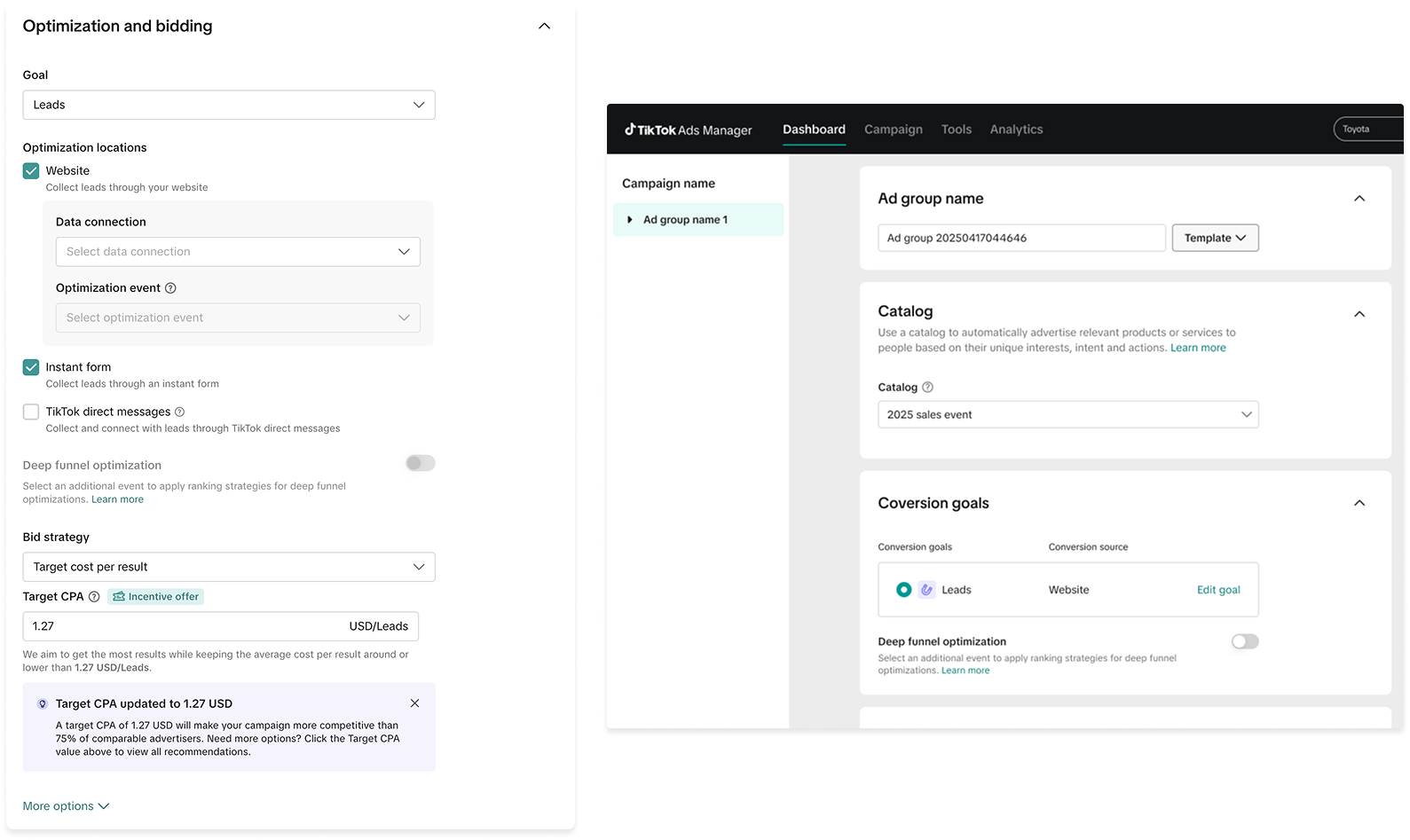
The optional vs. mandatory debate: my first instinct was to make Goals Hub mandatory. If advertisers skip it, signal pooling doesn't work at scale. But mandatory flows at the top of the funnel kill activation. I explored both directions before landing on opt-in with a >60% voluntary completion gate.
Final design
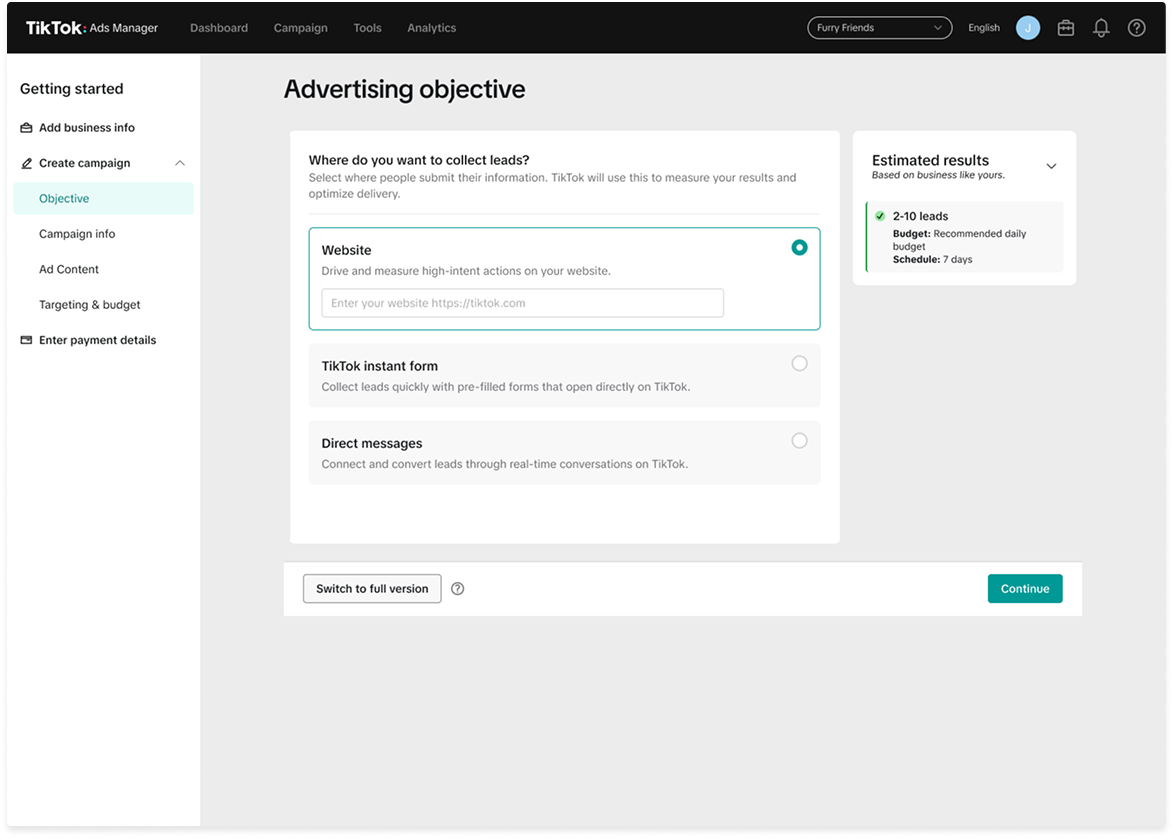
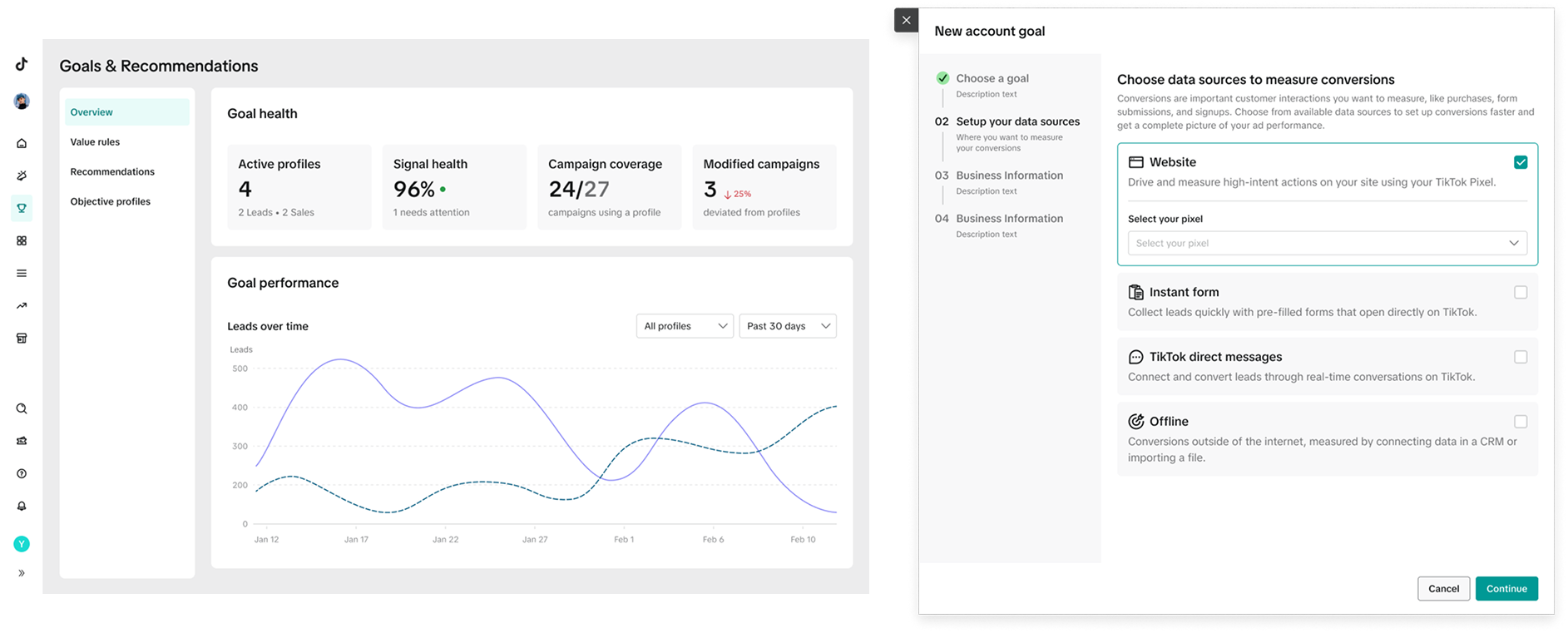
Goals Hub is designed as an optional account-level flow, surfaced to new advertisers and accessible from account settings at any time. Three components in Phase 1: Account Goal selection, Objective Profile configuration, and campaign-level inheritance with ad-group overrides. Currently in testing.
Outcomes
Currently in testing. DS projections show potential for significant reduction in setup time, abandonment, and Learning Phase fragmentation across both SMB and Key Account segments.
What's next
- Phase 2 — ML recommendations — Move from rules-based defaults to pattern-based recommendations. If an advertiser has historically run lead campaigns at $30 CPA with 7-day click window, the system suggests those settings automatically.
- Phase 3 — Intent driven campaign creation — The long-term vision: Goals Hub understands your intent so deeply that campaign creation becomes a confirmation flow, not a configuration flow.
- Feedback collection infrastructure — Thumbs, edit-rate tracking, and A/B testing of default variants as the system learns what "good defaults" look like per vertical and objective.
Reflections
Proud of the reframe — arriving at "the platform has no memory" from "reduce setup time," and the restraint of shipping a clean Phase 1 instead of overscoping towards the full vision. Would involve DS earlier in problem framing next time, not just solution review. We would have arrived at the Phase 1/2 split faster with stronger shared ownership of the model-side dependency.